Mon to sat Open: 10am - 6pm

Lesson 8 - Modem

  • Home
  • / Networking Fundamental
modem-image

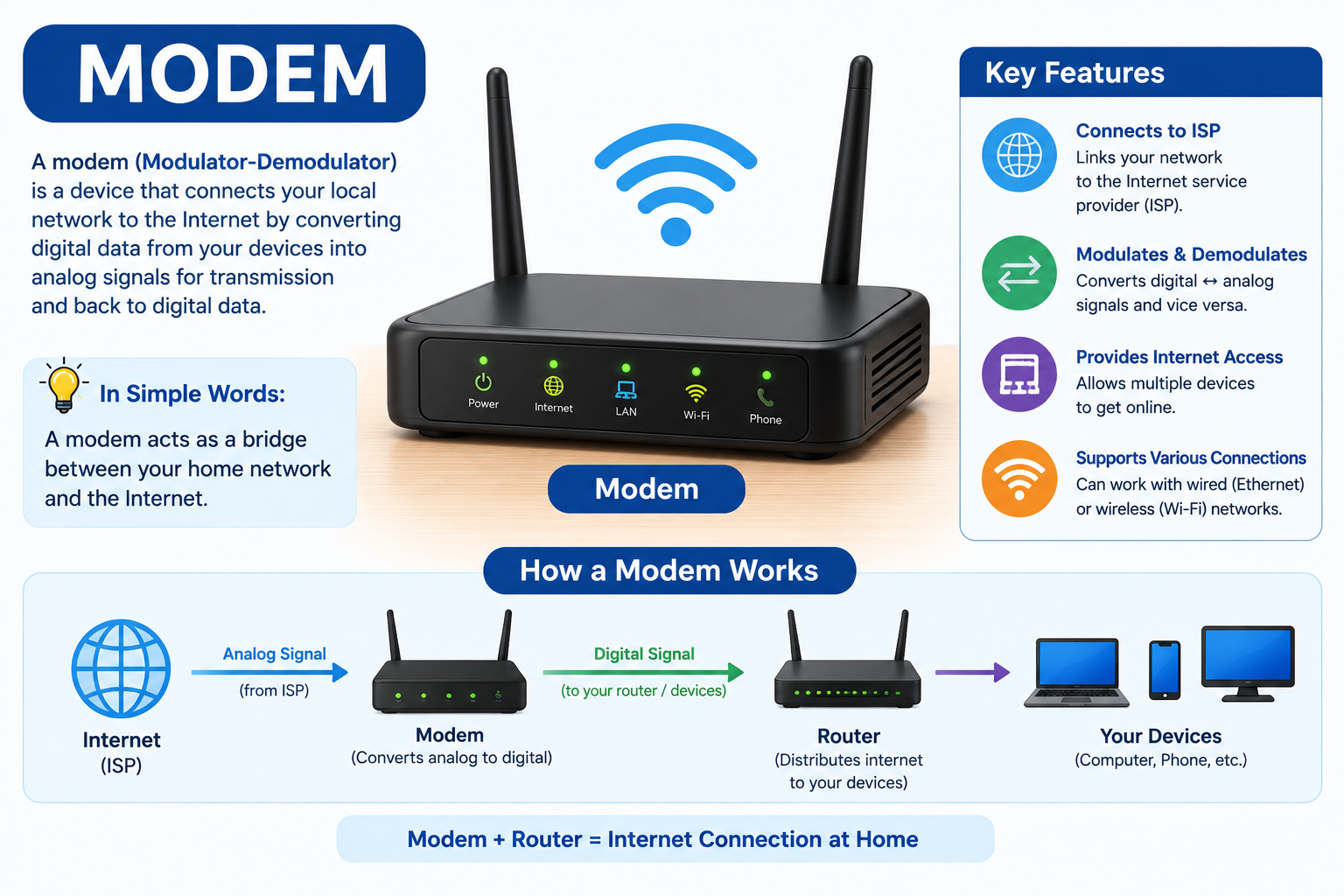
Modem


Modem is a device which attached to computer and convert digital signal to analog signal or vice versa. Digital signal is a group of discrete electronic unit that are transmitted in rapid succession while Analog signal consist of continues electrical waves.


Actually Modem is a short name for Modulator-Demodulator where Modulator can convert digital signal to analog signal and Demodulator does the opposite.


What’s the need of conversion of Analog to Digital or vice versa?


Let suppose you want to send data from your computer to someone else computer. Computer is an electronic machine works on digital signal so data is transmitting from your computer in a form of digital signal and also at the receiver end its receives data in digital form but telephones lines which act as a connection channel or network medium are works on analog signal. Since to make data transmittable by telephones lines you have to convert in a signal that they can carry so here we need a modem to convert the digital signal to analog signal or vice versa.


Speed of Modem –


Modems transmitted data in a different speed, measured by the number of bits of data they send in per second (bps). Example – 256 Kbps, 512 Kbps, 1 Mbps, 4Mbps etc.


Mode Of Data Transmission


There are several mode through which a data is transmitted at sender and receiver end. Here you gonna learn about the mode of data transmission.

  • 1. Simplex Mode
  • In a simplex mode communication system data can be transmitted only in one direction. Devices connected to such as circuit either can only send data (keyboard) or can only receive data (printer).

  • 2. Half Duplex
  • In a Half Duplex mode of communication system, you can have transmitted data in both directions but in only one direction at one time. Here, it can alternately send and receive data. It requires two wires hence it is most suitable for telephone communication in which only one person can speak at a time.

  • 3. Full Duplex
  • This mode of data transmission requires a four wires that allow data to flow in both directions a same time or simultaneously. Modern computer and internet are most popular example of this mode. Its improves efficiency because it eliminates the direction switching delay of half duplex.


    About the author

    vinay-bhatt-image

    Vinay Bhatt

    Vinay Bhatt is the Founder of LearnInCreation, an education and technology platform focused on making computer science and digital learning simple, practical, and accessible. He holds a B.Sc. degree from Kumaun University and has professional certifications in Full Stack Web Development, Digital Marketing, and Ethical Hacking. Passionate about education and technology, he creates beginner-friendly courses, practical learning resources, and projects that help students develop real-world skills and prepare for their careers.


    Course Lesson -

    Introduction, What is Networking, How Data Travel, Types of Network, Rules in Networking, Networking Topology, Network Transmission Media, Modem, Wireless or Unguided Media, Data Encoding, Networking Protocol, Protocol Data Unit

    Join Learnincreation Study Center

    Join LearnInCreation Study Center to learn practical computer and technology skills through simple lessons and hands-on training. Choose from Computer Basics, MS Office, Programming, Web Designing, Digital Marketing, and more. Get guidance, practice your skills, and prepare for your future. Visit our study center and enroll today!